
eTOM Framework – A Complete Guide for Telecom Professionals
Introduction
In the telecom industry, organizations manage thousands of processes — from customer acquisition and billing to network management and service assurance. To standardize and streamline these processes, the TM Forum introduced a global framework known as eTOM (Enhanced Telecom Operations Map).
eTOM is essentially the blueprint for running a telecom business efficiently. It defines what processes exist, how they interrelate, and how to align them across departments to deliver services effectively and profitably.
Table of Contents
What Is eTOM?
eTOM (Enhanced Telecom Operations Map) is a business process framework developed by the TM Forum — a global telecom industry association.
It provides a hierarchical map of all processes a service provider performs, grouped under categories such as Strategy, Operations, and Enterprise Management.
You can think of it as:
A “master operating manual” that helps telecom operators structure their business and IT processes in a consistent, industry-aligned way.
Key Objectives of eTOM
- Standardization: Provides a common language and process model for telecom companies worldwide.
- Process Integration: Bridges the gap between business, operations, and IT systems.
- Efficiency & Automation: Streamlines workflows to reduce redundancy and improve performance.
- Interoperability: Ensures different systems (CRM, OSS, BSS, etc.) can work together smoothly.
- Benchmarking: Enables comparison of processes and KPIs with global standards. 50 Most Important KPIs for your Business – Exceediance
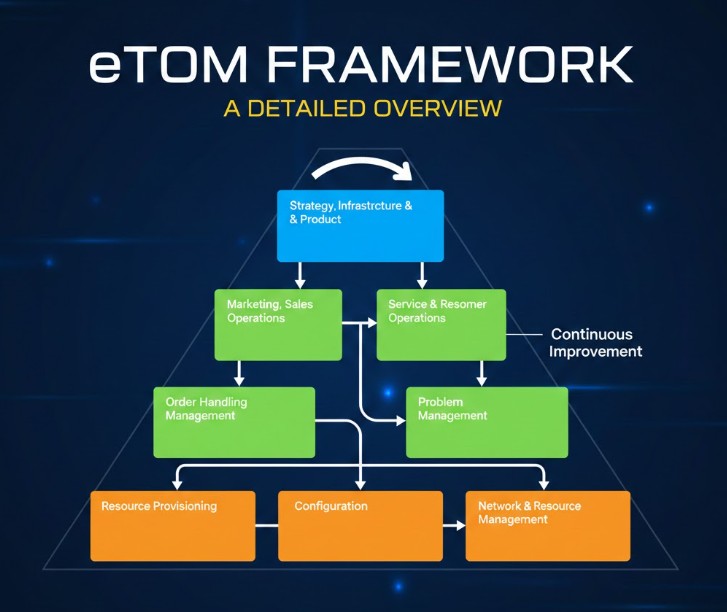
eTOM Structure: The Three-Level Framework
eTOM is organized into three major levels and three main process groupings, giving a clear view of how every activity fits within the telecom business ecosystem.
1. Main Areas
| Area | Description |
| Strategy, Infrastructure & Product (SIP) | Long-term planning, architecture, product lifecycle, and capability development. |
| Operations (OPS) | Core service delivery and customer management processes. |
| Enterprise Management (EM) | Corporate functions such as finance, HR, and strategic control. |
2. Horizontal Process Categories (High-level)
- Customer Relationship Management (CRM)
- Service Management & Operations
- Resource Management & Operations
- Supplier/Partner Relationship Management
- Support & Readiness
- Enterprise Risk and Knowledge Management
3. Vertical Layers
These describe how deep each process goes:
- Level 1: Major functional group (e.g., Operations)
- Level 2: Process category (e.g., Service Fulfillment)
- Level 3: Specific sub-processes (e.g., Configure Service, Test Service, Activate Service)
Simplified Example
Let’s say a customer subscribes to a new internet service.
| Process Stage | eTOM Example Process | Description |
| Order Received | Customer Relationship Management | Capture order and verify eligibility |
| Service Setup | Service Fulfillment | Configure, test, and activate service |
| Billing Started | Billing & Revenue Management | Generate bill and start charging |
| Fault Occurs | Service Assurance | Detect, isolate, and fix service issue |
| Ongoing Review | Performance Management | Monitor KPIs and customer experience |
This end-to-end flow maps directly to eTOM’s operational processes — ensuring consistency and control across teams.
Benefits of eTOM Framework
| Benefit | Description |
| Process Clarity | Everyone understands “who does what” across the company. |
| Reduced Silos | Encourages collaboration between network, IT, and business teams. |
| Operational Efficiency | Identifies redundant processes and bottlenecks. |
| Improved Customer Experience | Enables faster response and consistent service delivery. |
| Better System Integration | Forms the foundation for aligning OSS/BSS and automation platforms. |
| Strategic Benchmarking | Helps measure organizational maturity against global standards. |
| Supports Transformation | Aids digital transformation projects by providing clear process definitions. |
How To Implement eTOM in a Company
Implementation is typically done in phases, starting from understanding and mapping to integration and optimization.
Phase 1 – Awareness & Assessment
- Train key stakeholders about eTOM concepts.
- Conduct a process maturity assessment — what processes currently exist, how they overlap, and where the gaps are.
- Identify which areas of eTOM (Operations, SIP, or EM) are most relevant.
Phase 2 – Process Mapping
- Map current processes (AS-IS) to eTOM’s reference processes.
- Identify missing or redundant activities.
- Define the TO-BE model aligned with eTOM standards.
Phase 3 – Tool & System Alignment
- Align OSS/BSS architecture with eTOM’s process flows.
- For example:
- CRM ↔ Customer Relationship Management
- Network Operations ↔ Resource & Service Assurance
- Billing ↔ Revenue Management
Phase 4 – Governance & KPIs
- Assign ownership for each process group.
- Establish KPIs aligned with eTOM metrics (e.g., order-to-cash time, mean time to repair).
- Use dashboards for tracking (Power BI, ServiceNow, or ClickUp dashboards can work well here).
Phase 5 – Continuous Improvement
- Regularly audit and refine processes.
- Integrate ITIL, TAM, or SID (Shared Information Data Model) for deeper maturity.
- Move toward automation and AI-driven service management aligned with eTOM flows.
Integration with Other Frameworks
eTOM works best when combined with other telecom standards:
| Framework | Focus Area | How It Complements eTOM |
| ITIL | IT Service Management | Aligns IT operations with eTOM’s service processes. |
| TAM (Telecom Application Map) | Software Architecture | Links business processes (eTOM) with software components. |
| SID (Shared Information/Data Model) | Data Architecture | Defines a common data model for all systems in eTOM processes. |
| ISO 9001 / Six Sigma | Quality & Continuous Improvement | Ensures process compliance and optimization. |
Practical Tips for Implementation
- Start small: Focus on one domain (e.g., Service Fulfillment or Service Assurance).
- Build a cross-functional team: Include members from IT, operations, and business.
- Leverage visualization tools: Use tools like ARIS, Visio, or Bizagi to model processes.
- Establish governance: Create a Process Management Office (PMO) or assign process owners.
- Link with performance dashboards: Use Power BI or Tableau to track eTOM-based KPIs.
- Keep training ongoing: eTOM adoption succeeds only when employees understand its value.
Recommended Resources
| Resource | Description | Link |
| TM Forum eTOM Official Framework | Primary source of eTOM models and documentation | https://www.tmforum.org/business-process-framework/ |
| TM Forum Learning Portal | Offers official eTOM certification and online training | https://www.tmforum.org/training/ |
| “GB921 Series” Documents | eTOM technical specifications and process guides | Available on TM Forum site |
| Books | Telecom Operations Management Solutions with eTOM by TM Forum | Amazon / TM Forum store |
| eTOM + ITIL Whitepapers | Practical mappings for service providers | TM Forum knowledge base |
| YouTube Channels | Visual overviews of eTOM concepts (search: “TM Forum eTOM explained”) | Free |
| LinkedIn Groups | Join “TM Forum Professionals” or “Telecom Process Architecture” | Networking & Discussions |
Example Use Case: Telecom Operator Applying eTOM
Scenario:
A telecom operator faces delayed service activations and poor fault management.
Steps Taken:
- Conducted eTOM-based process assessment.
- Identified overlapping processes between CRM and network ops.
- Realigned “Service Fulfillment” and “Service Assurance” workflows.
- Integrated customer orders from CRM to OSS automatically using eTOM mapping.
- Result: Order-to-activation time reduced by 25%, fault resolution improved by 30%.
Conclusion
eTOM is not just a documentation framework — it’s a strategic foundation for running a modern telecom business.
By clearly defining what processes exist and how they should interact, eTOM empowers organizations to deliver better services, improve efficiency, and accelerate digital transformation.
For new professionals, mastering eTOM means understanding the “language” of telecom operations — a vital skill for roles in PMO, Service Delivery, OSS/BSS, and Digital Transformation.