
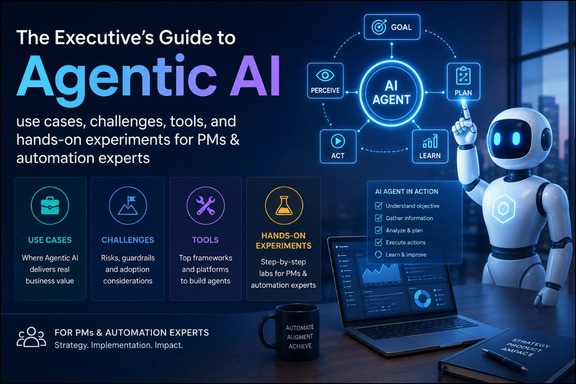
Beyond Chatbots: The Executive’s Guide to Agentic AI
We have moved past the era of “generation.” The new buzzword isn’t about creating text or images; it’s about action. Welcome to the world of Agentic AI—autonomous systems that don’t just answer questions but achieve goals.
Unlike traditional AI that requires a human to prompt every step, Agentic AI acts as a digital employee. It plans, reasons, uses tools, and executes multi-step workflows with minimal supervision.
Table of Contents – The Executive’s Guide to Agentic AI
Part 1: What is Agentic AI?
As part of The Executive’s Guide to Agentic AI, let us understand that Agentic AI refers to systems that exhibit autonomous goal-directed behavior. Based on the concept of “AI agents,” these systems combine Large Language Models (LLMs) with three critical capabilities:
- Planning: Breaking a high-level goal (e.g., “Book a Q3 client summit venue”) into sub-tasks.
- Memory: Retaining context across long workflows (both short-term session memory and long-term vector databases).
- Tool use: Interacting with external APIs, databases, or software (e.g., Slack, Outlook, Salesforce, SQL).
Simple Analogy:
- Chatbot: A librarian who tells you where a book might be.
- Agentic AI: A research assistant who borrows your library card, walks to the shelf, scans three books, summarizes them, emails you the notes, and updates your spreadsheet.
Part 2: Business Use Cases (Solving Real Problems Today)
While general artificial general intelligence is distant, narrow agentic workflows are solving practical pain points right now.
| Industry | Use Case | Practical Problem Solved |
|---|---|---|
| Customer Support | Tier-1 resolution agents | Automatically resetting passwords, processing returns, or refunding orders without human intervention. |
| IT Operations | Self-healing infrastructure | Agent detects a server log error → queries KB article → runs a PowerShell script to restart service → verifies health. |
| HR / Recruitment | Candidate screening & scheduling | Agent parses 500 resumes, scores fit, emails top candidates to find a time, and adds them to the hiring manager’s calendar. |
| Finance | Invoice reconciliation | Agent extracts PDF invoice data, checks PO in ERP, flags mismatches for human review, and posts approved invoices. |
| Project Management | Dependency tracking & status updates | Agent monitors Jira/GitHub; when a dev closes a ticket, it notifies QA, updates the Gantt chart, and posts a Slack status. |
Real Example: A logistics company used an agent to monitor weather APIs, re-route delivery trucks automatically, and notify customers—cutting delay response time from 45 minutes to 12 seconds.

Part 3: Current Challenges & Limitations
Agentic AI is powerful but not production-ready for high-stakes use without guardrails.
- The “Drift” Problem: Agents can get stuck in loops (e.g., repeatedly checking a calendar instead of booking it). They may also “hallucinate” tool arguments.
- Latency & Cost: An agent making 50 LLM calls to book a flight costs more in tokens and time than a human doing it.
- Security & Permissions: Granting an agent access to your CRM, email, and Slack creates a breach vector. How do you audit an agent’s “thoughts”?
- No True Understanding: Agents succeed at pattern matching, not reasoning. If an edge case isn’t in training data, they fail silently.
- Lack of Standardization: Every framework (LangChain, AutoGen, CrewAI) handles memory and tool calling differently.
Part 4: Future Expectations (Next 24 Months)
- Agent-to-Agent (A2A) Protocols: Agents will negotiate with other agents (e.g., your travel agent bot negotiates with a hotel revenue management bot).
- Embedded OS-level Agents: Microsoft Copilot and Apple Intelligence will evolve from features into system-wide agents that orchestrate all your apps.
- Human-in-the-loop (HITL) as default: Not full autonomy, but “escalation-only” workflows where agents handle 95% of actions and flag 5% to humans.
- Agent observability: New tools will visualize an agent’s “decision tree,” making black boxes transparent for audits.

Part 5: Recommended AI Tools (By Maturity)
For Beginners / Low-Code
- Zapier AI (Agents): Connect 6,000+ apps. Great for “if this, then do multi-step AI action.”
- Make.com (with OpenAI module): Allows basic agentic loops with routers and aggregators.
- Relevance AI: Build and deploy custom agents with a UI; good for non-engineers.
For Developers / Custom Workflows
- LangChain / LangGraph: The standard for building stateful, cyclical agents (plan-execute-observe).
- Microsoft Autogen: Best for multi-agent conversations (e.g., a coder agent + manager agent + QA agent).
- CrewAI: High-level orchestration for “crews” of agents with roles.
- Dust.tt: Designed for robust production agents with version control and tracing.
For Experimentation (No-Code Agent Builders)
- GPT-4o with Actions (Custom GPTs): OpenAI’s “Actions” let you define APIs (Retrieval, Code Interpreter, File search) – a mini-agent.
- Claude 3.5 Sonnet (Computer Use Beta): Experimental—the AI moves your cursor and clicks buttons like a human.
Part 6: Practical Experiments for PMs & Automation Experts
You don’t need a software engineering degree. Here are three 2-hour experiments using accessible tools.
Experiment 1: The “Daily Standup Scribe” (Low-code)
Goal: An agent that reads yesterday’s Jira tickets, writes a standup summary, and posts to Slack.
- Tools: Zapier AI + Slack + Jira (or Trello).
- Flow: Schedule trigger (8:00 AM) → Agent reads completed tickets → Summarizes in bullet points → Posts to #daily-standup.
- Learning: How to handle missing data (e.g., no tickets = post “no updates”).
Experiment 2: The “Meeting Action Item Extractor” (Medium-code)
Goal: Transcribe a meeting (or use a fake transcript), extract action items, assign owners, and create Asana tasks.
- Tools: OpenAI API (GPT-4o) + Python (or Google Colab) + Asana API.
- Flow: Transcript → Agentic prompt: “Identify action items, guess owners based on context, format JSON” → Python script creates tasks.
- Learning: Structured output (JSON mode) vs. free text; handling ambiguous ownership.
Experiment 3: The “Personal Email Triage Agent” (High-value, personal)
Goal: An agent that reads incoming emails, categorizes them (urgent, read-later, spam), and drafts replies.
- Tools: LangGraph (local) + Gmail API + Simple LLM (e.g., Ollama with Llama 3.2 for privacy).
- Flow: Fetch unread emails → Agent decides: “Needs reply? Needs action? Contains date?” → If date, suggest calendar block.
- Learning: State management; how to break when loop limit is reached.
Bonus: “The Hallucination Monitor”
Experiment: Give an agent a fake API tool (e.g., get_weather(city) that always returns null). See how many retries or different arguments it tries before giving up. This teaches you agent robustness.
Final Verdict: Is Agentic AI Ready?
Yes for internal, low-stakes automation.
No for external, customer-facing, high-risk decisions.
Start with human-in-the-loop agents (approval required before sending an email or updating a database). Use observability tools from day one. And remember: an agent that fails quietly is far worse than a human who raises their hand.
Your pilot project? Automate your own weekly status report generation. If the agent breaks, you lose 10 minutes. If it works, you save an hour.
Go build.