
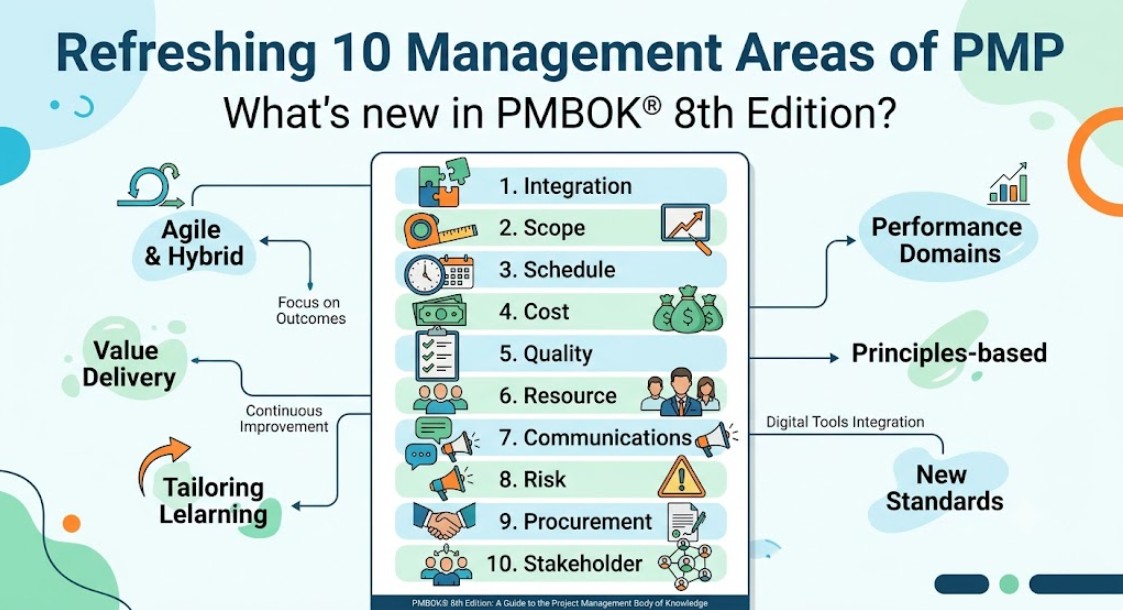
Refreshing 10 Management Areas of PMP
The Project Management Institute (PMI) has historically relied on structured Knowledge Areas to define the foundational domains of project execution. While the evolution of the A Guide to the Project Management Body of Knowledge (PMBOK® Guide) has shifted toward a principle- and domain-based framework to encompass predictive, agile, and hybrid environments, the classic 10 Management Areas of PMP remain the bedrock of technical, tactical project delivery.
Table of Contents
Part 1: The 10 Knowledge Areas of Project Management
The core concepts supporting each of the classic 10 Knowledge Areas are detailed below, complete with a structured breakdown of their essential execution frameworks.
1. Project Integration Management
Integration Management serves as the connective tissue of the project, ensuring all moving parts align with organizational strategy and business objectives.
- Project Charter: A formal document that authorizes the existence of a project and grants the project manager authority to apply organizational resources to project activities.
- Change Control Board (CCB): A formally constituted group responsible for reviewing, evaluating, approving, delaying, or rejecting changes to the project, ensuring all alterations are systematically documented.
- Lessons Learned Register: An ongoing repository that captures variances, insights, and successful techniques throughout the project lifecycle to continuously improve organizational execution.
- Project Management Plan: A comprehensive, consolidated document that integrates all individual management plans (scope, schedule, cost, etc.) and baselines into a single roadmap that defines how the project will be executed, monitored, and controlled.
- Integrated Change Control: A holistic process where changes to any part of the project (such as timeline shifts or budget adjustments) are evaluated together, ensuring a change in one area doesn’t secretly disrupt another before approval is granted.
- Project Closeout & Transition Framework: A formal set of procedures used to verify product acceptance, finalize administrative paperwork, release resources, and systematically hand over the final product or service to operational teams.
Check out our excellent guide on How to Upgrade Yourself to an AI Project Manager: A Practical Career Roadmap
2. Project Scope Management
Scope Management defines, validates, and controls exactly what work is included in the project—and ensures that only the required work is executed.
- Work Breakdown Structure (WBS): A hierarchical decomposition of the total scope of work to be carried out by the project team to accomplish the project objectives and create the required deliverables.
- Scope Creep: The uncontrolled expansion to product or project scope without adjustments to time, cost, and resources, which frequently threatens project delivery.
- Requirements Traceability Matrix (RTM): A grid that links product requirements from their origin to the deliverables that satisfy them, ensuring each requirement adds business value and is fully tested.
3. Project Schedule Management
Schedule Management establishes the timeline, operational sequences, and tracking mechanisms necessary to ensure the project finishes within its approved duration.
- Critical Path Method (CPM): A sequence of dependent tasks that determines the shortest possible duration of a project; any delay in critical path tasks directly pushes back the final project completion date.
- Total Float (Slack): The amount of time that a scheduled activity can be delayed or extended from its early start date without delaying the project finish date or violating a schedule constraint.
- Resource Leveling: A technique in which start and finish dates are adjusted based on resource constraints, often smoothing out resource over-allocations at the cost of extending the schedule.
4. Project Cost Management
Cost Management encompasses the budgeting, estimation, and financial controls required to complete the project within its approved financial baseline.
- Analogous Estimating: A top-down technique that uses the values (such as scope, cost, budget, and duration) from a previous, similar project as the basis for estimating the current project.
- Earned Value Management (EVM): A methodology that combines scope, schedule, and resource measurements to assess project performance and progress dynamically through indices like CPI (Cost Performance Index).
- Contingency Reserve: Financial allocations set aside within the cost baseline to mitigate “known-unknowns,” which are identified risks that have a planned response strategy.
5. Project Quality Management
Quality Management integrates the organization’s quality policy into the project, ensuring that deliverables meet both the technical specifications and the functional needs of the stakeholders. The Future of PMO: AI-Driven Predictive Risk Intelligence Dashboard
- Cost of Quality (COQ): The total cost incurred by investing in preventing nonconformance to requirements, appraising product quality, and failing to meet requirements (rework).
- Quality Assurance (QA): An execution-phase auditing process that ensures organizational processes are being followed correctly, preventing defects from occurring in the final output.
- Quality Control (QC): The operational monitoring and measurement activity used to determine if project deliverables meet specified technical standards before they are handed over to the client.
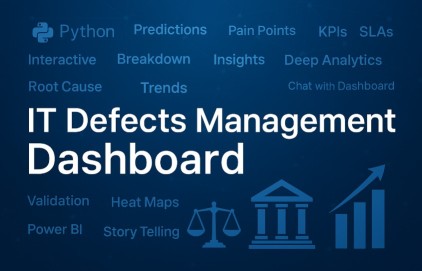
IT Defects Management Dashboard Power BI Template Stunning Visuals – Exceediance
6. Project Resource Management
Resource Management involves identifying, acquiring, and managing both the human team members and physical capital (materials, equipment, facilities) necessary for project success.
- RACI Matrix: A common type of responsibility assignment matrix used to clarify project roles by identifying who is Responsible, Accountable, Consulted, and Informed for each task.
- Tuckman Ladder: A framework describing team development stages—Forming, Storming, Norming, Performing, and Adjourning—guiding project managers on how leadership styles must adapt over time. Tuckman Ladder Model And His Stages of Team Development – Bakkah
- Forming – Team meets; polite, uncertain, dependent on leader.
- Storming – Conflicts arise; disagreement over roles and approaches.
- Norming – Resolve differences; establish trust, norms, and cohesion.
- Performing – Work smoothly; high performance and autonomy.
- Adjourning – Complete work; disband and reflect (added later).
- Emotional Intelligence (EI): The capacity to identify, assess, and manage the personal feelings of oneself, the team, and external groups to minimize conflict and sustain motivation.
- Self-Awareness – Recognize your own emotions, strengths, and triggers.
- Self-Regulation – Control impulses, adapt to change, and stay calm under pressure.
- Motivation – Stay optimistic, committed, and driven beyond external rewards.
- Empathy – Understand and consider team members’ feelings and perspectives.
- Social Skills – Build rapport, resolve conflicts, and communicate clearly.
- Impact – Improves stakeholder engagement, team morale, and project outcomes.
7. Project Communications Management
Communications Management ensures that the collection, generation, distribution, and storage of project information are executed effectively and efficiently.
- Communication Channels Formula: A mathematical representation ($n(n-1)/2$, where $n$ represents the number of stakeholders) used to calculate complex communication path growth as groups expand.
- Interactive Communication: A multi-directional exchange of information in real-time, such as meetings or phone calls, requiring active confirmation that the message was received and understood.
- Push / Pull Communication: Push communication sends information directly to recipients (emails, memos) without verifying receipt, while Pull communication requires recipients to access content at their own discretion (intranets, share drives).
8. Project Risk Management
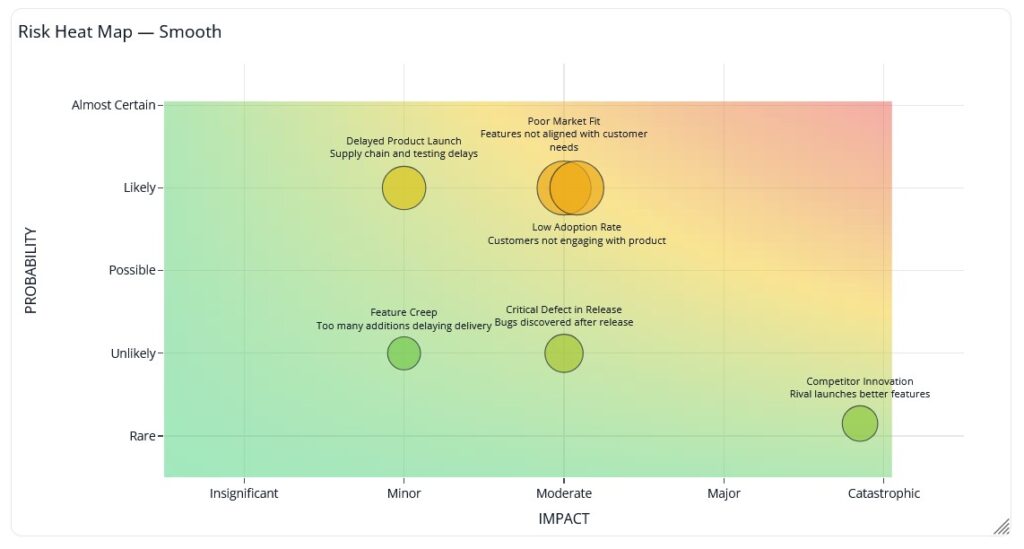
Risk Management involves conducting risk identification, analysis, response planning, and ongoing tracking to maximize positive opportunities and minimize negative threats.
- Risk Register: A central repository where all identified risks, their potential impacts, root causes, probability scores, and specific owners are formally logged and monitored.
- Qualitative vs. Quantitative Risk Analysis: Qualitative analysis prioritizes risks subjectively based on probability and impact, whereas Quantitative analysis numerically calculates the combined financial and schedule exposure using tools like Monte Carlo simulations.
- Risk Mitigation / Exploitation: Mitigation covers actions taken to reduce the probability or impact of a negative threat, while Exploitation focuses on eliminating uncertainty to ensure a positive opportunity occurs.
- Plan Risk Management – Define how to approach and conduct risk activities.
- Identify Risks – Find potential threats and opportunities that could affect the project.
- Qualitative Analysis – Prioritize risks by probability and impact.
- Quantitative Analysis – Numerically analyze the effect of risks on objectives.
- Plan Responses – Develop actions to enhance opportunities and reduce threats.
- Implement Responses – Execute the planned risk response strategies.
- Monitor Risks – Track identified risks, watch for new ones, and evaluate effectiveness.
Check out our free tool on creating your own Heat Map Risk Management Reports
9. Project Procurement Management
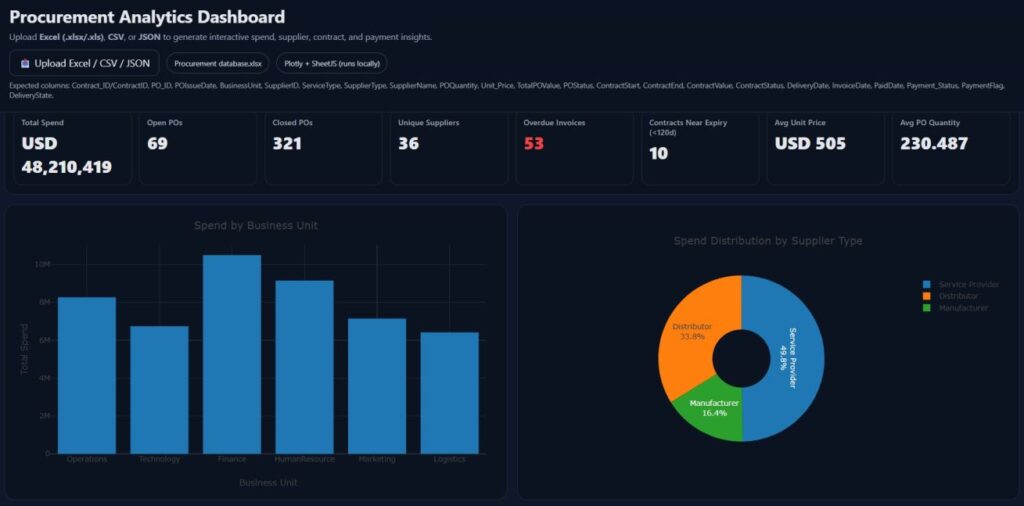
Procurement Management handles the acquisition of products, services, or results needed from outside the performing project team. 20 Procurement Best Practices: A Complete Guide to Efficiency, Savings, and Strong Supplier Relationships – Exceediance
- Statement of Work (SOW): A narrative description of the products, services, or results to be delivered by a vendor under a formal procurement agreement.
- Fixed-Price vs. Cost-Reimbursable Contracts: Fixed-Price contracts establish a set price for a well-defined scope, placing risk on the buyer/seller balance, while Cost-Reimbursable contracts pay the seller for actual allowable costs plus a fee, placing more risk on the buyer.
- Source Selection Criteria: A set of predefined attributes (such as technical capability, past performance, and financial stability) used to evaluate and score competing vendor proposals.
Create An Awesome Procurement Analytics Dashboard Using ChatGPT in 10 Minutes – Exceediance
10. Project Stakeholder Management
Stakeholder Management focuses on identifying the individuals, groups, or organizations that could affect or be affected by the project, and developing strategies to engage them effectively.
- Power/Interest Grid: A classification tool that groups stakeholders based on their level of authority (power) and level of concern (interest), dictating tailored engagement strategies.
- Stakeholder Engagement Assessment Matrix: A tool used to map out the current versus desired engagement levels of key individuals (e.g., Unaware, Resistant, Neutral, Supportive, Leading) to address gaps.
- Stakeholder Register: A highly confidential management document containing identification details, assessment findings, and classification metrics for every recognized project stakeholder.
The 12 Project Management Principles (PMBOK® 7th Edition)
Unlike the prescriptive processes of the previous edition, these 12 principles serve as fundamental, universal guidelines for strategy, decision-making, and problem-solving in any project context . They are designed to be adaptable and are infused throughout the project lifecycle.
- Be a Diligent, Respectful, and Caring Steward: Act responsibly with integrity, care, and trustworthiness, demonstrating a broad commitment to the project’s financial, social, and environmental impacts while ensuring compliance with internal and external guidelines .
- Create a Collaborative Project Team Environment: Foster an inclusive and collaborative environment that enables individuals with diverse skills and knowledge to work together effectively, achieving shared objectives more efficiently than they could alone .
- Effectively Engage with Stakeholders: Proactively engage stakeholders to the degree needed to contribute to project success and customer satisfaction. This involves understanding their needs, power, and influence, and maintaining open dialogue to align their expectations with project goals .
- Focus on Value: Continually evaluate and adjust the project to ensure it remains aligned with business objectives and intended benefits. Value is the ultimate indicator of project success, shifting the focus from just completing deliverables to delivering outcomes .
- Recognize, Evaluate, and Respond to System Interactions: View the project as a system with interconnected parts. Use a holistic perspective to understand and respond to the dynamic internal and external circumstances that can affect project performance .
- Demonstrate Leadership Behaviors: Effective leadership is not tied to a specific role. It involves adapting leadership behaviors to support individual and team needs, characterized by vision, motivation, coaching, and active listening to foster an ethical and adaptable environment .
- Tailor Based on Context: Since every project is unique, design the project’s development approach and processes based on its specific context, objectives, stakeholders, governance, and environment, using “just enough” process to maximize value and speed .
- Build Quality into Processes and Deliverables: Maintain a focus on quality throughout the project to produce deliverables that meet project objectives and stakeholder needs. This leads to higher productivity and faster delivery .
- Navigate Complexity: Continually evaluate and navigate project complexity, which can arise from human behavior, system interactions, uncertainty, and technology. Addressing complexity proactively helps the team stay on course .
- Optimize Risk Responses: Continually evaluate exposure to both opportunities (positive risks) and threats (negative risks) to maximize positive impacts and minimize negative impacts on the project and its outcomes .
- Embrace Adaptability and Resiliency: Build adaptability and resilience into the organization’s and project team’s approach. This enables the team to respond effectively to change, recover from setbacks, and keep the work moving forward .
- Enable Change to Achieve the Envisioned Future State: Prepare those impacted for the adoption and sustainment of new behaviors and processes required for the transition from the current state to the desired future state that the project creates .
| Aspect | PMBOK 6 | PMBOK 7 | PMBOK 8 |
|---|---|---|---|
| Primary Focus | Processes | Principles & Performance | Not released |
| Structure | 10 Knowledge Areas + 49 Processes | 12 Principles + 8 Performance Domains | TBD |
| Project Delivery | Mostly Predictive | Predictive, Agile & Hybrid equally emphasized | TBD |
| Methodology | Process-driven | Outcome-driven | TBD |
| Tailoring | Limited emphasis | Strong emphasis | TBD |
| Agile | Separate Agile Practice Guide | Fully integrated | TBD |
| Value Delivery | Secondary | Central concept | TBD |
| Artifacts/Models | Processes, Inputs, Tools, Outputs (ITTOs) | Models, Methods & Artifacts | TBD |
PMBOK 6 – Knowledge Areas (10)
| # | Knowledge Area |
|---|---|
| 1 | Project Integration Management |
| 2 | Project Scope Management |
| 3 | Project Schedule Management |
| 4 | Project Cost Management |
| 5 | Project Quality Management |
| 6 | Project Resource Management |
| 7 | Project Communications Management |
| 8 | Project Risk Management |
| 9 | Project Procurement Management |
| 10 | Project Stakeholder Management |
PMBOK 7 – Performance Domains (8)
| # | Performance Domain |
|---|---|
| 1 | Stakeholders |
| 2 | Team |
| 3 | Development Approach & Life Cycle |
| 4 | Planning |
| 5 | Project Work |
| 6 | Delivery |
| 7 | Measurement |
| 8 | Uncertainty |
PMBOK 7 – Project Management Principles (12)
| # | Principle |
|---|---|
| 1 | Be a diligent, respectful, and caring steward |
| 2 | Create a collaborative project team environment |
| 3 | Effectively engage stakeholders |
| 4 | Focus on value |
| 5 | Recognize, evaluate, and respond to system interactions |
| 6 | Demonstrate leadership behaviors |
| 7 | Tailor based on context |
| 8 | Build quality into processes and deliverables |
| 9 | Navigate complexity |
| 10 | Optimize risk responses |
| 11 | Embrace adaptability and resilience |
| 12 | Enable change to achieve the envisioned future |
How To Memorize 12 Principals to Practice
Acronym Method: “STEWARD CLERK” (one word per principle)
- Stewardship
- Team (Collaborative)
- Engage (Stakeholders)
- Worth (Value)
- Adaptability & Resilience
- Risk (Optimize)
- Deliver (Quality)
- Complexity (Navigate)
- Leadership
- Enable Change
- Responses (System Interactions)
- Know Your Context (Tailor)
Evolution at a Glance
| PMBOK 6 | PMBOK 7 |
|---|---|
| 10 Knowledge Areas | 8 Performance Domains |
| 49 Processes | No prescribed processes |
| ITTO-heavy | Outcome-focused |
| Project Manager-centric | Team-centric |
| Predictive emphasis | Predictive + Agile + Hybrid |
| Compliance focused | Value focused |
| Plan-driven | Tailored delivery |
| “How to manage” | “What success looks like” |
A simple way to remember the transition
| PMBOK 6 | PMBOK 7 |
|---|---|
| What should I do? (Processes) | What should I achieve? (Outcomes) |
| Knowledge Areas | Performance Domains |
| ITTOs | Principles |
| Project Management | Value Delivery |
| Methodology | Tailoring |
This captures the biggest conceptual shift between the two editions.
Since PMBOK 8 is not yet available, there’s no official set of knowledge areas, performance domains, or principles to compare.