
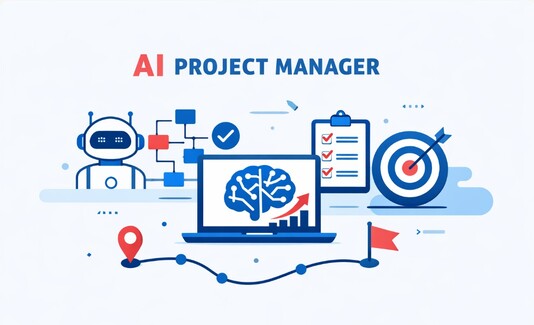
AI Project Manager: A Practical Career Guide for Project Managers Transitioning into AI Delivery
Introduction
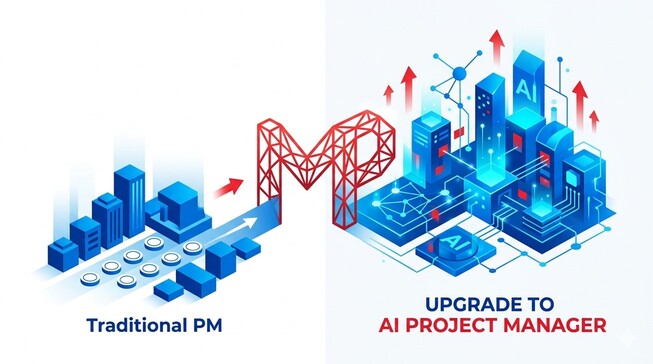
Artificial Intelligence (AI) has moved beyond research laboratories and technology startups. Today, organizations across healthcare, telecommunications, government, retail, manufacturing, consulting, and professional services are investing heavily in AI-driven initiatives to improve efficiency, automate processes, enhance decision-making, and create new business opportunities. This is a guide on how to Upgrade Yourself to an AI Project Manager
As AI adoption accelerates, a new role has emerged within many organizations: the AI Project Manager.
Many experienced Project Managers, Program Managers, PMO Leads, Transformation Managers, and Change Managers assume that AI Project Management requires deep coding expertise or a background in Data Science. In reality, most organizations require professionals who can bridge the gap between business objectives, technology teams, data specialists, and executive stakeholders based on new AI based business offerings.
This article explains what an AI Project Manager does, the knowledge areas required for success, how traditional Project Managers can transition into AI-focused roles, and which career paths become available after acquiring AI-related competencies.
Table of Contents
What is an AI Project Manager?
An AI Project Manager is responsible for planning, coordinating, governing, and delivering Artificial Intelligence initiatives that create measurable business value for wider Portfolio Management
The role combines traditional project management disciplines with an understanding of AI technologies, data management practices, governance requirements, and organizational change.
Unlike software development projects, AI projects introduce additional complexities including:
| Complexity | Explanation |
|---|
| Data Quality and Availability Challenges | Ensuring that sufficient, accurate, complete, and accessible data exists to train and operate AI solutions effectively. |
| Model Training and Validation Activities | Teaching an AI model using historical data and verifying that its outputs are accurate, reliable, and suitable for business use. |
| Ethical and Regulatory Considerations | Ensuring AI solutions comply with laws, industry regulations, privacy requirements, and accepted ethical standards. |
| Bias and Fairness Assessments | Evaluating AI outputs to identify and minimize unfair, discriminatory, or unintended outcomes affecting individuals or groups. |
| Ongoing Model Monitoring and Retraining | Continuously tracking AI performance after deployment and updating the model when data, business conditions, or accuracy requirements change. |
| AI Governance and Risk Management | Establishing policies, controls, accountability, and oversight mechanisms to ensure AI is used responsibly, securely, and effectively. |
An AI Project Manager ensures these activities are successfully coordinated while maintaining alignment with business goals.
Key Responsibilities of an AI Project Manager
Business Alignment
AI initiatives should solve business problems rather than simply deploy technology.
Typical responsibilities include:
- Defining business objectives
- Identifying AI use cases
- Establishing success criteria
- Measuring business benefits
- Tracking return on investment (ROI)
Example: AI-Powered Customer Service Chatbot
A telecommunications company receives thousands of customer queries every day, resulting in long wait times and high support costs.
| Step | Practical Example of Chatbot Project |
|---|---|
| Defining Business Objectives | Reduce customer support costs and improve response times for common customer inquiries. |
| Identifying AI Use Cases | Implement an AI chatbot capable of answering frequently asked questions such as billing inquiries, package details, and service status checks. |
| Establishing Success Criteria | The chatbot should automatically resolve at least 60% of customer queries and reduce average response time from 10 minutes to under 1 minute. |
| Measuring Business Benefits | After implementation, support agents handle fewer routine requests, customers receive faster responses, and customer satisfaction scores improve. |
| Tracking Return on Investment (ROI) | If the project costs $100,000 but reduces annual support costs by $250,000, the first-year ROI is 150%, generating a net benefit of $150,000. |
Stakeholder Management
AI projects typically involve diverse stakeholder groups:
- Executive leadership
- Business departments
- Data scientists
- Data engineers
- Solution architects
- Security teams
- Legal and compliance teams
- End users
Managing expectations across these groups is a critical success factor.
Governance and Risk Management
AI introduces risks not normally present in traditional projects.
Examples include:
- Biased outcomes
- Incorrect predictions
- Hallucinated responses
- Privacy concerns
- Regulatory violations
| Risk Area | Practical Example in the Chatbot Project |
|---|
| Biased outcomes | The chatbot performs better for English-speaking customers than Arabic-speaking customers because training data contains far more English interactions, leading to uneven service quality. |
| Incorrect predictions | The chatbot incorrectly identifies a customer’s billing issue and provides the wrong troubleshooting steps, causing repeated support calls. |
| Hallucinated responses | The chatbot confidently generates a response that sounds correct but is actually false, such as claiming a non-existent refund policy or offering incorrect plan details. |
| Privacy concerns | The chatbot accidentally exposes partial customer information (e.g., account status or last payment details) to an unauthenticated user due to weak access controls. |
| Regulatory violations | The chatbot stores or processes customer data in a way that violates data protection regulations, such as retaining personal data longer than permitted or using it without proper consent. |
AI Project Managers help establish governance structures that reduce these risks.
Change Management
AI projects often change how employees perform their work.
Successful adoption requires:
- Communication strategies
- Training programs
- Change impact assessments
- Stakeholder engagement
- Benefits realization tracking
| Change Area | Practical Example in the Chatbot Project |
|---|
| Communication strategies | Customers are informed that a new AI chatbot is being introduced to provide faster support, while internal teams are briefed on how their roles will shift from handling basic queries to focusing on complex issues. |
| Training programs | Customer service agents are trained on how to work alongside the chatbot, including handling escalations when the AI cannot resolve a query and interpreting chatbot-generated suggestions. |
| Change impact assessments | The organization evaluates how the chatbot will reduce call volume, how job roles in the support team will change, and what new skills employees will need to adapt to AI-assisted workflows. |
| Stakeholder engagement | Regular alignment sessions are held with customer support leadership, IT teams, compliance, and business executives to ensure expectations are managed and concerns are addressed early. |
| Benefits realization tracking | After deployment, the business tracks whether the chatbot actually reduces call center load, improves resolution time, increases customer satisfaction, and lowers operational costs compared to baseline metrics. |
How AI Projects Differ from Traditional IT Projects
| Traditional IT Project | AI Project |
|---|---|
| Requirements are usually fixed | Requirements evolve through experimentation |
| Testing verifies functionality | Testing verifies accuracy and effectiveness |
| Success measured by delivery | Success measured by business outcomes |
| Development is deterministic | AI outcomes are probabilistic |
| Deployment often ends the project | Continuous monitoring is required |
| Limited dependency on data quality | Data quality is critical |
Understanding this distinction is one of the first steps toward becoming an effective AI Project Manager.
Core AI Terminology Every Project Manager Should Understand
Project Managers do not need to become Data Scientists. However, they should understand the terminology used by technical teams.
Artificial Intelligence (AI):
A broad field focused on enabling machines to perform tasks that normally require human intelligence. Artificial Intelligence refers to the broad field of creating systems that can perform tasks normally requiring human intelligence, such as understanding language, recognizing patterns, making decisions, or generating content. In business terms, AI is used to automate or enhance decision-making and improve efficiency across processes
Machine Learning (ML)
A subset of AI where systems learn patterns from data and improve over time. Machine Learning is a subset of AI where systems learn patterns from historical data and improve their performance over time without being explicitly programmed for every rule. For example, a system can learn from past customer behavior to predict future demand or detect anomalies in transactions
Generative AI
AI systems capable of creating content such as text, images, audio, video, or software code.
Examples include:
- ChatGPT
- Microsoft Copilot
- Google Gemini
Large Language Models (LLMs)
Advanced AI models trained on massive amounts of text data to generate human-like responses. A Large Language Model is a type of AI trained on vast amounts of text data to understand and generate human-like language. Tools like chat-based assistants use LLMs to answer questions, write content, summarize documents, and support decision-making in natural language
Examples include:
- GPT models
- Gemini models
- Claude models
Prompt Engineering
The practice of designing effective instructions that improve AI outputs. Prompt Engineering is the practice of designing clear and effective instructions (prompts) to guide an AI system to produce better and more relevant outputs. It is similar to how requirements are written for a system, but in natural language for AI tools
Retrieval-Augmented Generation (RAG)
A technique that allows AI models to access internal company knowledge before generating responses. RAG is a technique where an AI system first retrieves relevant information from trusted external sources (such as company databases or documents) and then uses that information to generate an accurate response. This helps ensure the AI answers are grounded in real and up-to-date organizational knowledge rather than relying only on pre-trained data.
Fine-Tuning
Further training a pre-trained AI model using organization-specific data.
AI Agents
Autonomous systems capable of performing tasks, making decisions, and interacting with multiple tools. AI Agents are intelligent systems that can independently perform tasks, make decisions, and take actions using tools or systems with minimal human intervention. Unlike simple chatbots, AI agents can execute multi-step workflows such as analyzing data, sending emails, or updating systems automatically.
MLOps
A framework that manages the deployment, monitoring, governance, and maintenance of machine learning models. MLOps is the set of practices used to deploy, monitor, and maintain machine learning models in production. It ensures that AI models are not just built, but are continuously tested, updated, and managed reliably—similar to how DevOps works for software applications.
Data Concepts Every AI Project Manager Should Learn
Data is the foundation of every successful AI initiative.
Many AI projects fail because of poor data rather than poor technology.
Data Governance
The framework that defines how organizational data is managed, protected, and controlled.
Data Quality
Ensuring data is:
- Accurate
- Complete
- Consistent
- Timely
- Reliable
Data Lineage
Understanding where data originated and how it has been transformed.
Master Data Management (MDM)
Maintaining a consistent version of critical business information across systems. Maintaining a consistent version of critical business information across systems refers to ensuring that key organizational data—such as customer details, product information, employee records, or financial figures—is accurate, synchronized, and identical across all applications and platforms where it is used.
In many organizations, the same data is stored in multiple systems (for example, CRM, billing systems, data warehouses, and reporting tools), and if these systems are not properly aligned, inconsistencies can occur. Master Data Management (MDM) practices help create a “single source of truth,” so that everyone across the business works with the same trusted version of information. This is especially important in AI and analytics initiatives, because inconsistent data can lead to incorrect insights, unreliable predictions, and poor decision-making.
Data Privacy
Protecting personal and sensitive information while complying with regulations.
Data Architecture
Understanding how data flows across systems and applications.
For many Project Managers, Data Governance and Data Management represent the most valuable areas for career development because they directly support AI initiatives.
AI Governance and Responsible AI
As AI adoption increases, governance becomes a critical capability.
Organizations increasingly require leaders who understand Responsible AI principles.
Key concepts include:
AI Bias
AI systems may unintentionally produce unfair outcomes. AI bias refers to situations where an AI system produces unfair or skewed outcomes for certain groups of people due to imbalanced or incomplete training data. For example, if historical hiring data reflects unconscious bias, an AI recruitment tool may unintentionally favor one gender or nationality over another. Managing AI bias involves identifying these imbalances early, testing outputs across different user groups, and ensuring fairness in decision-making.
Explainability
Organizations must understand how AI-generated decisions are made. Explainability is the ability to understand and clearly describe how and why an AI system reached a specific decision or output. In business environments, stakeholders need to trust AI recommendations, which is only possible if the system can provide understandable reasoning behind its results—for example, why a loan application was approved or rejected. Without explainability, AI becomes a “black box,” which reduces trust and limits adoption
Transparency
Users should know when AI is involved in decision-making. Transparency means being open about how AI systems are designed, what data they use, and when AI is being used in a process. It ensures that users and stakeholders are aware that an AI system is involved in decision-making and understand its limitations. For example, a chatbot should clearly indicate that it is AI-powered and not a human agent. Transparency builds trust and supports responsible adoption.
Accountability
Organizations remain responsible for AI-driven outcomes. Accountability refers to clearly defining who is responsible for the outcomes of an AI system, even when the system operates autonomously. Organizations must ensure that ownership is established for AI decisions, including errors or unintended consequences. For example, if an AI system provides incorrect financial advice, the business—not the algorithm—is still responsible. Clear accountability structures are essential for governance and risk control.
Security
AI systems must be protected against misuse and cyber threats. Security in AI involves protecting models, data, and systems from unauthorized access, misuse, or attacks. This includes securing training data, preventing manipulation of AI inputs (such as prompt injection attacks), and safeguarding outputs that may contain sensitive information. Strong security ensures that AI systems cannot be exploited or compromised, especially when they are integrated into critical business processes
Compliance
AI solutions must comply with applicable regulations and industry standards. Compliance ensures that AI systems follow relevant laws, regulations, and industry standards, particularly around data privacy, ethics, and usage. This may include regulations such as GDPR or sector-specific requirements in finance or healthcare. Compliance also involves maintaining audit trails, ensuring proper consent for data usage, and meeting internal governance policies. In AI projects, compliance is not optional—it is a core design requirement from the beginning.
Project Managers who understand these topics are often well-positioned for AI leadership roles.

Recommended Training and Certifications
Microsoft AI Fundamentals (AI-900)
Official Learning Path:
https://learn.microsoft.com/en-us/credentials/certifications/azure-ai-fundamentals
Provides a strong introduction to AI concepts, machine learning, and Generative AI.
Google Generative AI Learning Path
https://www.skills.google/paths/1951
Focuses on modern Generative AI technologies and practical business applications.
Project Management Focus
PMI AI Resources
Provides AI-related learning materials specifically designed for Project Management professionals.
Data Governance Focus
DAMA International
Widely recognized authority on Data Management and Data Governance best practices.
Cloud and Enterprise AI
Microsoft Learn
FREE – Introduction to generative AI and agents – Training | Microsoft Learn
Google Cloud Training
https://cloud.google.com/training
AWS Training
https://aws.amazon.com/training
These platforms provide valuable knowledge on enterprise AI implementation.
Practical Experience You Can Build Without an AI Job
Many Project Managers assume they need formal AI experience before applying for AI-related positions.
This is not always true.
Consider creating practical examples such as:
- AI-powered PMO reporting assistant
- Executive dashboard automation
- Project risk prediction prototype
- Meeting summarization solution
- Knowledge management chatbot
- Resource forecasting assistant
- AI-enabled lessons learned repository
| Heading & Goal | Practical Demonstration (No-Code / Low-Code Approach) |
|---|---|
| 1. AI-Powered PMO Reporting Assistant Automate status report generation from Jira, Excel, or MS Project. | Use Zapier + OpenAI or Make.com + ChatGPT. Feed exported Jira/Excel tasks into a prompt: “Summarize these 20 tasks into a project status report: risks, accomplishments, next steps.” Output a ready-to-paste report for Slack/Teams. |
| 2. Executive Dashboard Automation Refreshable dashboard with natural language query. | Use Power BI or Tableau Public + Power BI Copilot (or Google Looker Studio + Gemini API). Feed sample project data (budget, schedule, health). Demonstrate: “Show me at-risk tasks for next week” → chart updates instantly. |
| 3. Project Risk Prediction Prototype Flag potential delays before they happen. | Use Airtable + OpenAI classification (or Langflow). Input: task type, team velocity, blockers, past delay trend. Prompt: *“Score risk 1-10 and explain why.”* Compare predicted vs actual outcomes for 5–10 historical tasks. |
| 4. Meeting Summarization Solution Turn a transcript into action items and decisions. | Record a 5-min mock project meeting. Use Otter.ai, Fireflies.ai, or Whisper + ChatGPT. Show raw transcript → AI summary with: Decisions, Action Items (owner/due date), Risks raised. Highlight 30-min time saved per meeting. |
| 5. Knowledge Management Chatbot Answer project questions from past documents. | Build a custom GPT (ChatGPT) or use Dify.ai (free). Upload 3–4 past artifacts (charter, risk log, lessons learned). Demo queries: “What caused the budget overrun in Project X?” or “How did we resolve vendor delays last time?” |
| 6. Resource Forecasting Assistant Predict when team members will be over/under-allocated. | Use Smartsheet (Resource Management with AI) or GanttPro + Excel Forecast Sheet. Feed 3 months of allocation data. Apply SheetAI in Google Sheets with prompt: “Given this history and 2 upcoming milestones, forecast workload by person for next 4 weeks.” |
| 7. AI-Enabled Lessons Learned Repository Auto-categorize and suggest reusable lessons. | Build in Notion or Coda with AI fields. Columns: Title, Phase, Impact, Recommendation. AI auto-tags (e.g., “Vendor mgmt,” “Scope creep”). Second AI field: “Related past lessons.” Search: “Show lessons for testing phase failures.” |
These initiatives demonstrate practical understanding and provide valuable interview examples.
Career Paths After Developing AI Competencies
After developing AI knowledge, Project Managers may target several emerging roles.
- AI Project Manager: Leads individual AI initiatives from concept through deployment.
- AI Program Manager: Coordinates multiple AI projects across a business unit or enterprise.
- AI Transformation Manager: Leads organizational adoption of AI technologies and operating models.
- AI PMO Lead: Establishes governance, standards, reporting, and portfolio management for AI initiatives.
- Data and AI Transformation Lead: Combines data modernization and AI delivery responsibilities.
- AI Governance Manager: Focuses on responsible AI, compliance, risk management, and governance frameworks.
- Enterprise AI Delivery Manager: Oversees large-scale AI implementations involving multiple teams and vendors.
- Digital Transformation Director: Leads broader transformation initiatives where AI serves as a key capability.
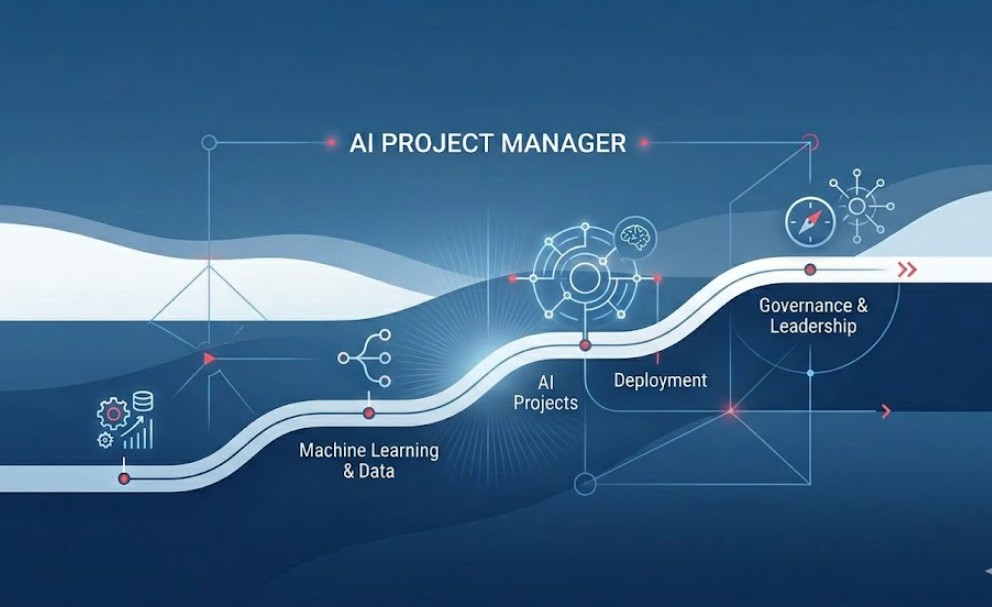
A Suggested Learning Roadmap for Traditional Project Managers
Phase 1 – AI Foundations
Learn:
- AI fundamentals – Introduction to generative AI and agents – Training | Microsoft Learn
- Machine learning basics
- Generative AI concepts
- Large Language Models LLMs
Phase 2 – Data Foundations
Learn:
- Data Governance
- Data Quality
- Data Architecture
- Master Data Management
Phase 3 – AI Delivery
Learn:
- AI project lifecycle
- MLOps fundamentals
- AI operating models
- Vendor management
Phase 4 – AI Governance
Learn:
- Responsible AI
- AI risk management
- Ethics and compliance
- Security considerations
Phase 5 – Practical Application
Develop:
- AI use cases
- Pilot solutions
- Transformation roadmaps
- Business cases
Phase 6 – Professional Branding
Update:
- LinkedIn profile
- CV
- Certifications
- Portfolio examples
Position yourself as a leader in Data and AI Transformation rather than attempting to compete directly with Data Scientists or AI Engineers.
Conclusion
The emergence of AI does not diminish the importance of Project Management; it increases it.
Organizations need professionals who can translate business goals into successful AI outcomes, coordinate multidisciplinary teams, manage risks, establish governance, and ensure adoption.
Traditional Project Managers already possess many of the leadership, governance, stakeholder management, and delivery skills required for AI initiatives. The primary areas for development are AI fundamentals, data management, AI governance, and practical understanding of AI delivery models.
For experienced Project Managers, PMO Leads, Program Managers, and Transformation Leaders, the transition to AI Project Management is not a complete career change. It is a strategic evolution of existing capabilities that positions them for some of the most in-demand leadership roles of the next decade.
This guide was created by Junaid Tahir using a collaborative approach with multiple AI tools and Training portals (ChatGPT, DeepSeek, Gemini, Microsoft Copilot, DAMA, CDMP, Google AI). Each recommendation, terminology, and resource was cross-referenced against official training pages and real-world PM practices. The structure, prompts, and quality control were considered while compiling because AI is a tool, but delivery expertise is human. If you have feedback, questions, or a real-world example to share, Junaid invites you to connect on LinkedIn