
A Formal Guide to Portfolio Management
Table of Contents
1. What is Portfolio Management?
Portfolio Management is the centralized management of one or more portfolios to achieve strategic objectives. It involves identifying, prioritizing, authorizing, managing, and controlling projects, programs, and other related work to meet specific business goals.
Unlike project management (focused on specific outputs) or program management (focused on benefits from related initiatives), portfolio management is strategic. It answers: “Are we doing the right things?” and “Are we optimizing our resource investments to deliver maximum value?”
Key Characteristics:
- Strategic alignment: Every component must link to organizational strategy.
- Value optimization: Selecting the mix of initiatives that yields the highest overall benefit.
- Resource balancing: Allocating constrained resources (people, budget, technology) across competing initiatives.
- Risk management: Managing portfolio-level risk (e.g., over-concentration in one market or technology).
2. Portfolio Management Components
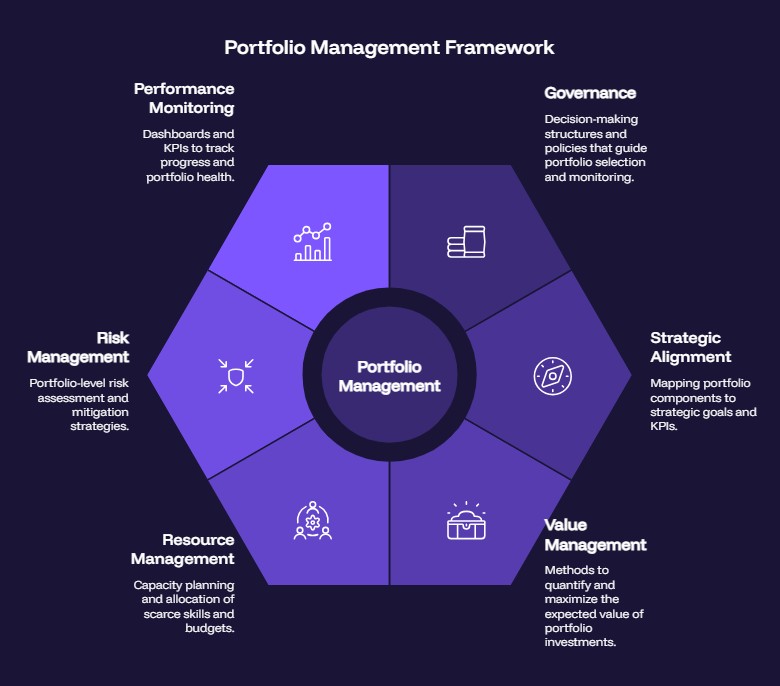
A robust portfolio management system comprises six core components:
| Component | Description |
|---|---|
| 1. Governance | Decision-making structures, policies, and controls that guide portfolio selection, monitoring, and adjustment. |
| 2. Strategic Alignment | A clear mapping from portfolio components to strategic pillars or KPIs (e.g., growth, efficiency, compliance). |
| 3. Value Management | Methods to quantify, track, and maximize expected value (NPV, ROI, strategic scoring). |
| 4. Resource Management | Capacity planning, demand management, and allocation of scarce skills and budgets. |
| 5. Risk Management | Portfolio-level risk assessment (e.g., correlation of risks across projects) and mitigation strategies. |
| 6. Performance Monitoring | Dashboards, KPIs, and reporting to track progress, benefits realization, and portfolio health. |
3. Responsibilities of a Program or Governance Manager in Portfolio Management
While a dedicated Portfolio Manager owns the portfolio, a Program Manager or Governance Manager plays critical supporting and controlling roles. Their responsibilities are distinct but complementary.
A. Responsibilities of a Program Manager (Portfolio Context)
| Responsibility | Description |
|---|---|
| Component Delivery & Reporting | Ensure programs/projects under your purview deliver status, risks, and financial data to the portfolio system. |
| Benefits Realization | Track and validate that program benefits align with portfolio value targets. Escalate deviations. |
| Resource Feedback | Provide actual resource utilization vs. planned to enable portfolio capacity adjustments. |
| Dependency Management | Identify cross-program dependencies; manage them or escalate to portfolio level if conflicting. |
| Gate Review Participation | Present program at portfolio governance gates (e.g., stage-gate reviews, annual planning). |
| Risk Escalation | Escalate risks that could impact portfolio-level objectives (e.g., regulatory, market shifts). |
B. Responsibilities of a Governance Manager (Portfolio Context)
| Responsibility | Description |
|---|---|
| Governance Framework Design | Establish policies, standards, and decision rights for portfolio intake, prioritization, and termination. |
| Portfolio Oversight | Chair or support portfolio review boards; ensure compliance with governance rules. |
| Alignment Assurance | Validate that every proposed or ongoing initiative maps to a strategic objective; reject misaligned work. |
| Performance Audits | Conduct independent reviews to verify that portfolio data (status, value, risk) is accurate and truthful. |
| Exception Handling | Define processes for urgent portfolio changes (e.g., adding a high-priority project outside normal cycle). |
| Stakeholder Communication | Ensure portfolio decisions (kill, reprioritize, fund) are transparent and documented. |
| Governance Maturity | Drive continuous improvement of portfolio governance practices (e.g., moving from ad hoc to disciplined). |
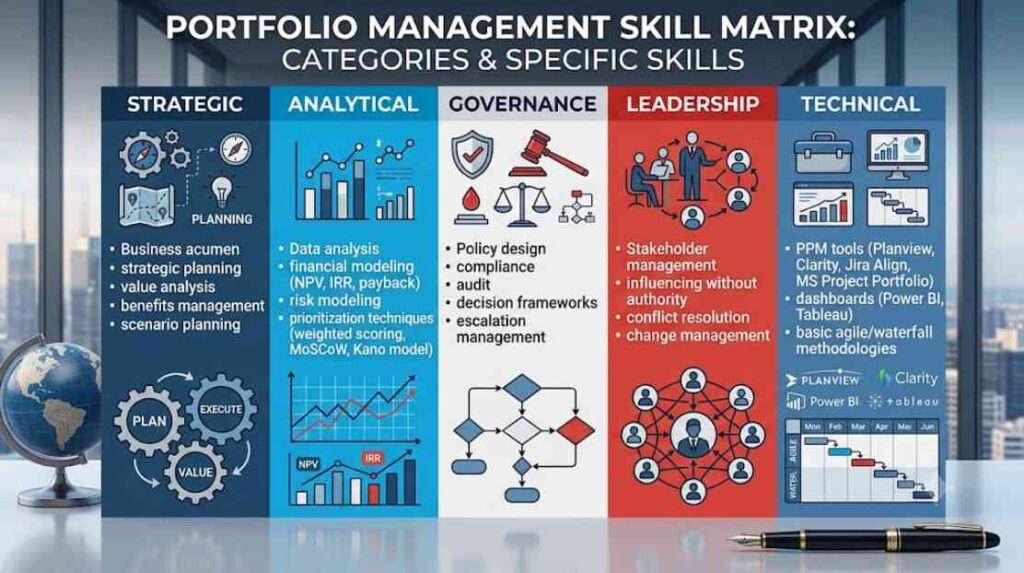
4. Required Skills for Portfolio Management Roles
| Skill Category | Specific Skills |
|---|---|
| Strategic | Business acumen, strategic planning, value analysis, benefits management, scenario planning |
| Analytical | Data analysis, financial modeling (NPV, IRR, payback), risk modeling, prioritization techniques (weighted scoring, MoSCoW, Kano model) |
| Governance | Policy design, compliance, audit, decision frameworks, escalation management |
| Leadership | Stakeholder management, influencing without authority, conflict resolution, change management |
| Technical | PPM tools (Planview, Clarity, Jira Align, MS Project Portfolio), dashboards (Power BI, Tableau), basic agile/waterfall methodologies |
5. Recommended Trainings & Certifications
| Certification | Focus | Issuer |
|---|---|---|
| PfMP (Portfolio Management Professional) | End-to-end portfolio management | PMI |
| MoP (Management of Portfolios) | Portfolio governance and strategic alignment | AXELOS |
| PgMP (Program Management Professional) | Program management (strongly overlaps with portfolio support role) | PMI |
| P3O (Portfolio, Programme, Project Offices) | Setting up governance and portfolio office | AXELOS |
| COBIT 2019 | Governance of enterprise IT (especially for Governance Managers) | ISACA |
| SAFe Portfolio Manager | Lean portfolio management in agile environments | Scaled Agile |
Suggested Training Courses:
- PMI: PfMP Exam Prep, Portfolio Management Fundamentals
- AXELOS: MoP Foundation & Practitioner
- LinkedIn Learning: Portfolio Management for Projects – Project Portfolio Management Foundations | LinkedIn Learning
- Coursera/EdX: Strategic Portfolio Management (University of Virginia)
6. Recommended Exposure & Experience
To be effective in portfolio-related roles, seek these experiences:
| Exposure Area | Why It Matters |
|---|---|
| Strategic planning cycles | Understand how annual/quarterly planning connects to initiative selection. |
| Stage-gate or lean portfolio reviews | See real decision-making, kill criteria, and prioritization debates. |
| Resource capacity management | Experience balancing competing demands with fixed teams/budgets. |
| Benefits tracking | Work with finance to measure actual vs. planned value; analyze variance. Finance for Project Managers: Guide) |
| Portfolio tool administration | Hands-on with PPM tools to understand data flow and reporting limitations. |
| Governance board participation | Observe how executives trade off risk, value, and strategic fit. |
| Post-mortems on killed initiatives | Learn why good ideas fail; improve portfolio governance. |
7. Formal Process Summary: Portfolio Management Lifecycle
1. STRATEGIC PLANNING
   - Define strategic objectives and KPIs
   - Set portfolio budget and risk tolerance

2. PORTFOLIO INTAKE & PRIORITIZATION
   - Collect proposals, score against strategy
   - Weighted scoring, ROI, strategic alignment
   - Select portfolio components

3. RESOURCE & CAPACITY PLANNING
   - Map demand to available capacity
   - Identify bottlenecks (people, skills, budget)

4. EXECUTION & MONITORING
   - Ongoing reporting on progress, cost, value, risk
   - Governance reviews (monthly/quarterly)

5. BENEFITS REALIZATION & ADJUSTMENT
   - Compare actual benefits to business case
   - Reallocate or kill underperforming components

6. PORTFOLIO OPTIMIZATION
   - Rebalance portfolio based on changing strategy, risk, or market
8. Key Artifacts for Governance & Program Managers
| Artifact | Owner | Purpose |
|---|---|---|
| Portfolio Charter | Governance Manager | Defines governance model, decision rights, policies |
| Strategic Alignment Matrix | Portfolio Manager | Maps each initiative to strategic goal |
| Prioritization Scorecard | Portfolio Manager | Weighted criteria used to rank initiatives |
| Resource Capacity Heatmap | PMO | Shows overallocation / underutilization |
| Portfolio Risk Register | Governance Manager | Correlated risks across initiatives |
| Benefits Realization Log | Program Manager | Tracks expected vs. actual benefits |
| Kill/Review Criteria Document | Governance Manager | Explicit thresholds for stopping or reprioritizing work |
Final Summary Table: Program vs. Governance Manager in Portfolio Context
| Aspect | Program Manager | Governance Manager |
|---|---|---|
| Primary role | Delivery & benefits | Compliance & oversight |
| Focus | Program-level execution | Portfolio-level rules & decisions |
| Escalation | Raises risks/variances | Enforces policies & reviews |
| Key output | Status reports, benefits data | Governance decisions, audit findings |
| Stakeholders | Project teams, sponsors | Executives, portfolio board, audit |