
The Complete Demand Management Guide: 9 Governance Pillars for Turning Business Requests into Deliverable Work
Every organization is flooded with more ideas, requests, and “urgent” asks than it can ever deliver. A regional director wants a new reporting dashboard. Compliance needs a policy change rolled out by next quarter. Marketing wants a campaign platform integrated with CRM. Engineering wants to pay down technical debt. None of these requests are unreasonable on their own — but taken together, without a formal system to capture, evaluate, and sequence them, they overwhelm delivery teams, starve strategic initiatives of capacity, and quietly erode trust between the business and IT or PMO functions. Demand Management Guide
Demand Management is the discipline that solves this problem. It is the formal, governed process by which an organization captures every request for work, understands its true business value and urgency, tests it against available capacity, and decides — deliberately, not accidentally — what gets worked on, when, and by whom.
This guide follows the same governance-first approach used in our other two guides in this series: A Formal Guide to Portfolio Management and The Complete Release Management Guide. Together, the three form a single value chain:
Demand Management (what should we even consider?) → Portfolio Management (what should we invest in?) → Release Management (how do we deliver it safely?)
If Portfolio Management answers “are we doing the right things?”, Demand Management answers the question that comes before it: “what are all the things we could possibly do, and which ones deserve a seat at the table?”
Table of Contents
1. What Is Demand Management?
Demand Management is the structured process of identifying, capturing, categorizing, evaluating, and prioritizing requests for new work — projects, enhancements, services, or changes — before they are approved for delivery. It is the intake and triage layer that sits upstream of portfolio selection and project execution.
Demand Management draws from two complementary traditions:
- ITIL / IT Service Management, where Demand Management is formally defined as the practice of understanding, predicting, and influencing customer demand for services, using tools such as Patterns of Business Activity (PBA) and User Profiles (UP) to forecast consumption and align it with Capacity Management.
- PMO / Portfolio Management practice, where Demand Management (often called “work intake”) is the gatekeeping process that determines which requests become formal projects, which are handled as operational “run the business” work, and which are declined or deferred.
Key Characteristics
- Single point of entry: All requests — regardless of source or size — flow through one standardized intake channel rather than arriving informally through email, hallway conversations, or executive mandate.
- Objective evaluation: Requests are scored against consistent criteria (strategic alignment, value, urgency, risk, effort) rather than approved based on who is asking loudest.
- Capacity-aware: Demand is only converted into committed work once it has been tested against realistic resource, budget, and infrastructure capacity.
- Continuous, not one-off: Demand arrives constantly, so the process is a standing operating rhythm — weekly triage, monthly grooming, quarterly governance boards — not a single annual exercise.
- Traceable: Every request has a documented owner, status, and disposition, so nothing is lost, forgotten, or approved twice.
Done well, Demand Management gives leadership the ability to say “not yet” or “no” with confidence and evidence, instead of saying “yes” to everything and watching delivery teams burn out under an unmanaged backlog.
2. Demand, Portfolio, and Release Management: How They Fit Together
Because this guide sits alongside our Portfolio and Release Management guides, it’s worth being precise about where each discipline starts and ends. Many organizations blur these together, which is exactly what causes chaotic intake, thrashing priorities, and blown release calendars.
| Dimension | Demand Management | Portfolio Management | Release Management |
|---|---|---|---|
| Core question | What work is being requested, and is it worth considering? | What should we invest in, given strategy and capacity? | How do we deliver approved work safely and predictably? |
| Primary input | Business/stakeholder requests, ideas, mandates | Approved and scored demand, strategic objectives | Approved portfolio items, change requests |
| Primary output | A qualified, prioritized pipeline of candidate work | An approved, funded portfolio of programs/projects | Deployed, verified releases in production |
| Time horizon | Continuous intake, rolling triage | Quarterly/annual planning cycles | Sprint/release cycle (weekly–quarterly) |
| Key governance body | Demand Review Board / Intake Committee | Portfolio Governance Board | Change Advisory Board (CAB) |
| Failure mode if absent | Uncontrolled backlog, scope creep, “shadow IT” requests | Wrong investments, strategic misalignment | Failed deployments, production incidents |
3. The 9 Governance Pillars of Demand Management
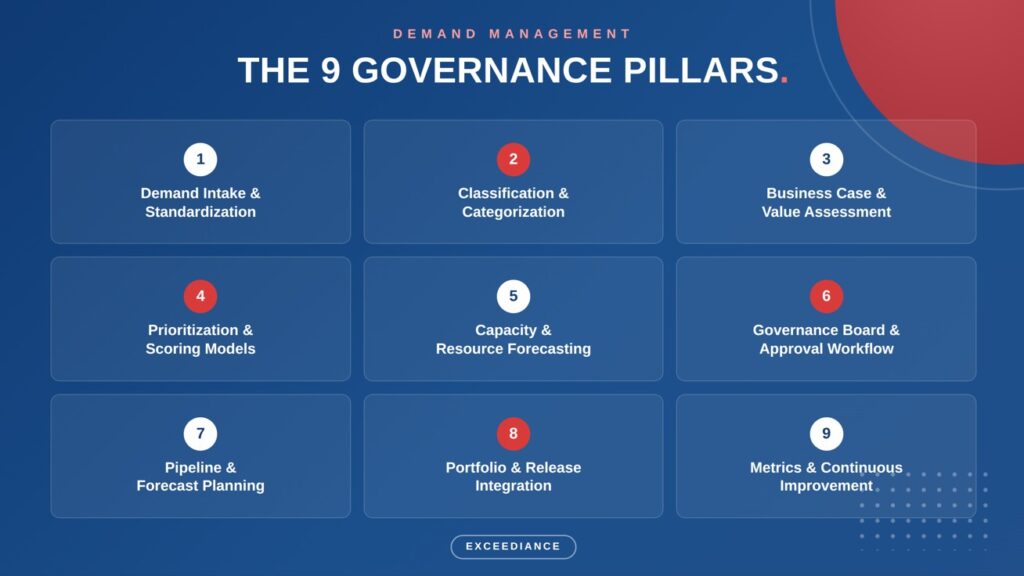
Pillar 1: Demand Intake & Request Standardization
What this means: Every request for work — no matter how small — enters through a single, standardized channel using a common intake form or ticket type. This might be a Jira request queue, a ServiceNow SPM form, or a simple structured intake template.
Why it matters: Without a single front door, demand arrives through dozens of informal channels — Slack messages, hallway conversations, executive emails — making it impossible to see, compare, or govern. Standardization also forces requestors to articulate the business need clearly before anyone commits time to it.
Recommended approach: Define the minimum viable information needed to triage a request — business sponsor, problem statement, desired outcome, urgency, and rough size — rather than demanding a full business case up front. Publish clear guidance on where and how to submit demand, and appoint Business Relationship Managers (BRMs) or Demand Owners for major business units to coach requestors and pre-screen submissions.
What could go wrong if ignored: Duplicate requests, “shadow” projects started without governance visibility, and a PMO that is perpetually surprised by work it didn’t know existed.
Pillar 2: Demand Classification & Categorization
What this means: Once captured, each request is classified — typically as run-the-business (operational, keep-the-lights-on), grow-the-business (incremental improvement), or transform-the-business (strategic, often multi-year initiatives) — and tagged by type (mandatory/compliance, strategic, tactical, break-fix).
Why it matters: A regulatory-mandatory change and a “nice-to-have” dashboard request cannot be evaluated on the same scale. Classification lets governance boards apply the right level of rigor and the right decision-makers to each category, rather than a one-size-fits-all review.
Recommended approach: Use a simple two-axis model — business criticality versus strategic value — to sort incoming demand into tiers. Mandatory/compliance-driven demand should be fast-tracked with minimal debate; everything else competes for prioritized capacity.
What could go wrong if ignored: Low-value convenience requests consume the same governance attention as transformational, revenue-generating initiatives — and strategic work quietly starves.
Pillar 3: Business Case & Value Assessment
What this means: Before a request is seriously considered, its requestor (supported by a BRM or analyst) articulates the expected value — cost savings, revenue impact, risk reduction, compliance necessity, or customer experience improvement — along with a rough order-of-magnitude cost and effort estimate.
Why it matters: Demand Management is not about saying “yes” to good ideas; it’s about comparing many good ideas against each other with consistent, defensible logic. Without a value articulation, prioritization decisions default to politics and seniority.
Recommended approach: Use a lightweight business case template scaled to the size of the request — a single paragraph for small tactical work, a full cost-benefit and ROI/NPV analysis for anything entering the strategic portfolio. Value assessment here feeds directly into the scoring models used in Portfolio Management.
What could go wrong if ignored: Vague, unquantified requests dominate the pipeline while genuinely high-value initiatives get lost in the noise because no one built the case for them.
Pillar 4: Prioritization & Scoring Models
What this means: Every qualified piece of demand is scored using a consistent, weighted model — typically combining strategic alignment, financial value, urgency, risk, and dependency factors — to produce a ranked, comparable list.
Why it matters: Ranking demand objectively is what allows leadership to make trade-off decisions transparently. It turns “everything is a priority” into an honest, ordered list that reflects actual organizational value.
Recommended approach: Build a simple weighted scoring matrix (e.g., strategic fit 30%, financial value 25%, urgency/risk 25%, effort/cost 20%) and visualize results on a value-versus-effort or risk-versus-value bubble chart so governance boards can see the whole pipeline at a glance rather than debating requests one at a time.
What could go wrong if ignored: Prioritization becomes a function of executive volume rather than business value — the loudest stakeholder wins, not the most valuable initiative.
Pillar 5: Capacity Alignment & Resource Forecasting
What this means: Demand is tested against realistic delivery capacity — people, skills, budget, and infrastructure — before it is approved. This borrows directly from ITIL’s concept of Patterns of Business Activity (PBA) and User Profiles (UP), which forecast when and how demand will actually materialize so capacity can be planned ahead of it, not reactively.
Why it matters: Approving more demand than the organization can deliver is the single most common cause of missed deadlines, burnout, and quality erosion. Capacity-blind prioritization is not prioritization at all.
Recommended approach: Maintain a rolling capacity model by team/skill, updated at least monthly, and require every approved demand item to be checked against it before formal commitment. Where capacity is structurally short, use demand management as the forum to make that shortage visible to leadership rather than absorbing it silently at the delivery level.
What could go wrong if ignored: Resource over-allocation, constant re-planning, and delivery teams working on five things at 20% focus instead of one thing at 100%.
Pillar 6: Demand Governance Board & Approval Workflow
What this means: A standing cross-functional body — the Demand Review Board, Intake Committee, or equivalent — meets on a regular cadence to review scored, capacity-checked demand and formally approve, defer, or reject it.
Why it matters: Without a body empowered to say “no,” every request eventually gets approved by attrition. The single most important success factor in demand governance is genuine organizational authorization to decline requests that don’t earn their place in the pipeline.
Recommended approach: Establish tiered decision authority — small, low-risk requests approved by a team lead or BRM; larger or cross-functional demand escalated to the governance board; transformational, high-cost initiatives escalated further into the Portfolio Governance Board. Batch decisions on a fixed cadence (e.g., monthly) rather than approving requests one-by-one as they arrive, which forces genuine trade-off thinking.
What could go wrong if ignored: Approval becomes a rubber stamp, governance meetings become status updates rather than decision forums, and the backlog grows faster than delivery capacity ever could.
Pillar 7: Pipeline & Forecast Planning
What this means: Beyond individual requests, Demand Management maintains a forward-looking view of expected demand — seasonal peaks, known regulatory deadlines, planned transformation waves — so the organization can plan capacity ahead of need rather than reacting to it.
Why it matters: Reactive demand management treats every request as a surprise. Mature demand management anticipates the shape of future demand using historical patterns, business plans, and industry cycles.
Recommended approach: Build a 12–18 month rolling demand forecast, reviewed quarterly alongside the portfolio planning cycle. In telecom and other regulated industries, this forecasting discipline connects naturally to broader industry process frameworks — for example, demand and fulfillment forecasting concepts within the eTOM framework help align internal demand pipelines with end-to-end operational and product lifecycle processes.
What could go wrong if ignored: Predictable spikes (year-end compliance pushes, seasonal traffic, product launch cycles) repeatedly catch delivery teams off guard, forcing rushed, under-governed decisions.
Pillar 8: Integration with Portfolio Selection & Release Scheduling
What this means: Approved demand doesn’t stop at the governance board — it must flow cleanly into portfolio selection cycles and, once funded, into release planning and calendars.
Why it matters: Demand Management that operates in isolation from Portfolio and Release Management creates a disconnect: requests get “approved” in principle but never actually make it onto a delivery calendar, or worse, get delivered without ever passing through proper portfolio prioritization.
Recommended approach: Treat the output of Demand Management as the direct input to the portfolio intake stage and ensure approved, funded demand is scheduled through the same governed calendar process described in our Release Management Guide The demand pipeline, portfolio backlog, and release calendar should be visibly and traceably linked — ideally in the same toolset.
What could go wrong if ignored: “Approved” work sits in limbo indefinitely, portfolio decisions are made without visibility into the full demand pipeline, and release calendars get blindsided by initiatives no one flagged early enough.
Pillar 9: Metrics, KPIs & Continuous Improvement
What this means: Demand Management performance is tracked using measurable indicators — intake volume, cycle time, approval/rejection rates, forecast accuracy — and reviewed periodically to improve the process itself.
Why it matters: A demand process without metrics cannot be improved; it can only be defended or complained about. Metrics turn demand management from a bureaucratic gate into a continuously improving capability.
Recommended approach: Track a small, meaningful set of KPIs (see Section 9 below), review them quarterly with the governance board, and adjust intake templates, scoring weights, and approval thresholds based on what the data shows.
What could go wrong if ignored: The process ossifies — templates and scoring models stay static for years even as business priorities shift, and the demand board loses credibility with the business it’s meant to serve.
4. Roles & Responsibilities in Demand Management
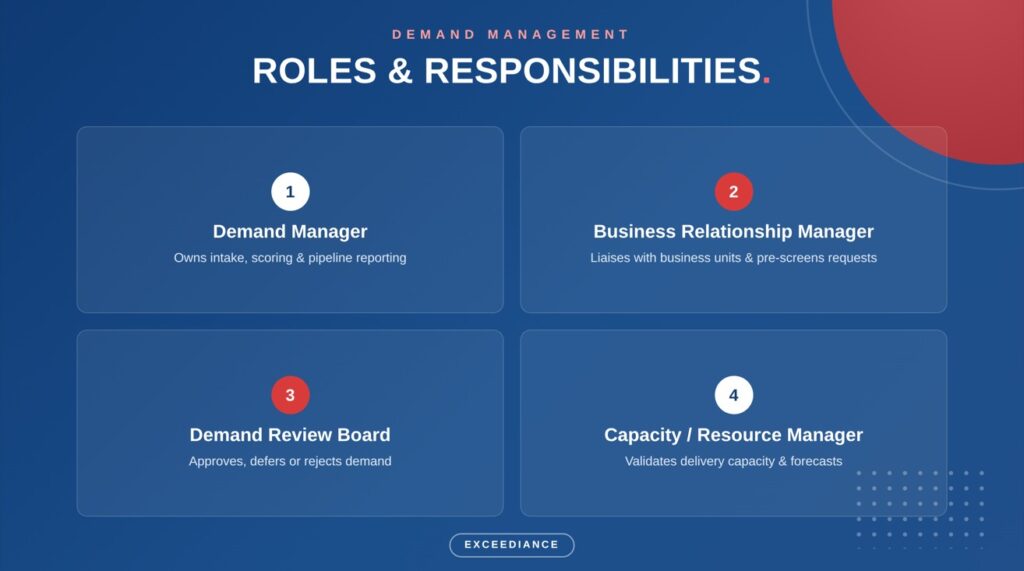
| Role | Core Responsibilities |
|---|---|
| Demand Manager | Owns the intake process end-to-end; maintains the standardized intake channel; facilitates scoring and prioritization; manages the demand pipeline and forecast; reports pipeline health to leadership. |
| Business Relationship Manager (BRM) / Demand Owner | Acts as the liaison between a specific business unit and the demand process; coaches requestors on submitting quality demand; pre-screens and refines requests before formal intake; represents business priorities in governance discussions. |
| Demand Review Board / Intake Committee | Cross-functional group that reviews scored, capacity-checked demand on a fixed cadence; approves, defers, or rejects requests; escalates strategic items to Portfolio Governance. |
| Capacity/Resource Manager | Maintains the rolling capacity model across teams and skills; validates that approved demand is realistically deliverable; flags structural capacity shortfalls to leadership. |
| Portfolio & Governance Manager | Receives approved, prioritized demand as input to portfolio selection; ensures continuity between demand governance and portfolio governance (see the portfolio Management Guide on Exceediance or the downstream role). |
5. Required Skills for Demand Management Roles
Effective demand managers and BRMs combine analytical rigor with relationship skills:
- Stakeholder facilitation and negotiation — helping requestors articulate real business need, and helping leadership make difficult trade-off calls without damaging relationships.
- Business analysis — translating vague requests into structured, comparable problem statements and value propositions.
- Financial literacy — comfortable with ROI, NPV, and cost-benefit reasoning well enough to sanity-check business cases.
- Data and reporting fluency — building and maintaining pipeline dashboards, forecast models, and scoring matrices (commonly in Power BI, Excel, or PPM tooling).
- Process design and governance discipline — designing intake workflows that are simple enough to use but rigorous enough to filter effectively.
- Systems fluency — comfortable working across ticketing, collaboration, and PPM platforms;
- AI and automation literacy — increasingly, demand managers use AI-assisted tools to triage, summarize, and pre-score incoming requests.
6. Recommended Trainings & Certifications
| Certification / Training | Focus Area | Issuer |
|---|---|---|
| ITIL 4 Foundation & Specialist (Create, Deliver & Support) | Demand and capacity management fundamentals within IT service management | AXELOS / PeopleCert |
| PMI Portfolio Management Professional (PfMP) | Portfolio-level prioritization and value optimization | Project Management Institute |
| Business Relationship Management Professional (BRMP) | Demand shaping, stakeholder relationship management | Business Relationship Management Institute |
| SAFe for Teams / SAFe Product Owner-Product Manager | Agile demand intake and backlog prioritization at scale | Scaled Agile, Inc. |
| Lean Six Sigma (Green/Black Belt) | Process design and continuous improvement for intake workflows | Various accredited providers |
| Certified Business Analysis Professional (CBAP) | Structured business case and requirements articulation | IIBA |
7. Tools & Technology Enablement
Modern demand management runs on a mix of intake, collaboration, and reporting tools rather than spreadsheets and inboxes:
- Ticketing/PPM platforms (Jira, ServiceNow SPM, Planview, Azure DevOps) for structured intake queues, workflow automation, and status tracking.
- Documentation and collaboration spaces (Confluence) for intake templates, business case documents, and governance board minutes.
- Reporting and visualization tools (Power BI, Tableau) for pipeline dashboards, scoring bubble charts, and capacity heat maps.
- AI-assisted triage — increasingly used to auto-summarize incoming requests, flag duplicates, suggest classification, and draft first-pass scoring, freeing human reviewers to focus on judgment calls. This shift is part of a broader change in how PM-adjacent roles operate, explored further in How to Upgrade Yourself to an AI Project Manager.
8. Demand Management in Regulated & Telecom Environments
In telecom and other heavily process-mapped industries, demand management doesn’t exist in a vacuum — it needs to align with broader operational process frameworks that govern how the enterprise plans, fulfills, and assures services. The eTOM (enhanced Telecom Operations Map) framework provides exactly this kind of end-to-end process backbone, spanning strategy and infrastructure planning through fulfillment and assurance.
While eTOM does not use the term “demand management” as a standalone process area, its Strategy, Infrastructure & Product domain and its Fulfillment processes within Operations are directly analogous: they exist to translate anticipated and actual customer/business demand into planned infrastructure, product, and delivery capacity. Organizations running formal demand management alongside an eTOM-aligned operating model should map their intake and prioritization pillars explicitly onto these process areas, so that demand governance reinforces — rather than duplicates or conflicts with — the enterprise process architecture already in place.
9. Risk Considerations in Demand Management
Demand Management is itself a risk control — a well-run intake and prioritization process prevents many of the risks that would otherwise surface later in delivery. But the process carries its own risks if poorly designed, particularly on large transformation programs where demand volume and stakeholder complexity are highest.
Common risk patterns include:
- Governance bypass risk — senior stakeholders routing requests around the formal intake process, undermining the entire model.
- Estimation risk — early-stage demand is sized too optimistically, leading to capacity commitments that later prove unrealistic.
- Strategic drift risk — scoring criteria not revisited as strategy shifts, so the pipeline keeps prioritizing yesterday’s priorities.
- Dependency blind spots — related demand items approved independently without visibility into shared dependencies or conflicting resource needs.
These risks compound significantly on large transformation initiatives, where dozens of interdependent demand streams converge. The structured risk identification, assessment, and mitigation approach described in our Risk Management Process for a Transformation Program guide applies directly here — treating the demand pipeline itself as a risk register input, not just a work list, is a hallmark of mature demand governance.
10. Key Artifacts for Demand Management
| Artifact | Owner | Purpose |
|---|---|---|
| Demand Intake Form/Template | Demand Manager | Standardizes information captured for every request |
| Demand Register / Pipeline Log | Demand Manager | Central, traceable record of every request and its status |
| Business Case (lightweight or full) | Requestor / BRM | Articulates expected value, cost, and urgency |
| Prioritization Scoring Matrix | Demand Manager | Ranks demand objectively against consistent criteria |
| Capacity Forecast Model | Capacity/Resource Manager | Tests demand against realistic delivery capacity |
| Governance Board Minutes & Decisions Log | Demand Manager | Documents approvals, deferrals, and rejections with rationale |
| Rolling Demand Forecast | Demand Manager | Anticipates future demand waves for proactive capacity planning |
11. Formal Process Summary: Demand Management Lifecycle
- Capture — Request submitted through the standardized intake channel.
- Classify — Request tagged by type and business criticality.
- Assess — Business case and value articulated; rough cost/effort estimated.
- Score — Request ranked using the weighted prioritization model.
- Check Capacity — Request tested against the rolling capacity forecast.
- Govern — Demand Review Board approves, defers, or rejects.
- Hand Off — Approved demand flows into portfolio and, once funded, onto the Release Callender.
- Monitor & Improve — Pipeline KPIs reviewed and process refined on a regular cadence.
12. Common Pitfalls & Anti-Patterns
- The “everything is priority one” trap — no real scoring model, so every request is labeled urgent, which means nothing actually is.
- Executive override culture — the demand board’s decisions are routinely overturned by direct executive appeals, which quickly trains the organization to bypass governance entirely.
- Intake without capacity checks — requests approved based on value alone, with resourcing treated as “someone else’s problem” downstream.
- One-and-done classification — demand scored once at intake and never revisited, even as scope, cost, or business context changes materially before delivery starts.
- Disconnected tooling — demand tracked in a spreadsheet that never talks to the portfolio or release systems, creating manual reconciliation and lost requests.
13. Metrics & KPIs for Demand Management
| KPI | What It Measures |
|---|---|
| Intake-to-decision cycle time | How long requests wait for a governance decision |
| Demand approval / rejection / deferral rate | Health and rigor of the prioritization process |
| Forecast accuracy | How closely predicted demand matched actual demand |
| Percentage of demand from standardized intake vs. informal channels | Adoption and discipline of the intake process |
| Capacity utilization vs. approved demand | Whether approved work is realistically resourced |
| Time from approval to portfolio/release entry | Effectiveness of the demand-to-delivery handoff |
Conclusion
Demand Management is the discipline organizations most often skip — and pay for later. Without it, portfolios get filled with whatever was requested loudest, release calendars get ambushed by work no one planned for, and delivery teams absorb the cost of decisions made without real prioritization. With a formal demand management practice in place — standardized intake, objective scoring, capacity-aware approval, and a clean handoff into portfolio and release governance — organizations gain something rare: the ability to say “no” or “not yet” with confidence, and the credibility to make “yes” mean something.